Paul is not Talking about Himself: Why I take the "pre-Christian" Reading of Romans 7:14-25
Earlier this semester, my good friend Ken Berding and I were discussing the different views on Romans 7:14-25 and decided that we would each write a blog post summarizing our reasons for holding opposing views on the passage. Last week, Ken gave a great defense of the view that Romans 7:14-25 is autobiographical and is thus about the Christian struggle with sin. I found Ken’s reasons 3, 6 and 7 very strong (Ken also gave a fine experiential discussion of that struggle in an earlier post). As Ken pointed out, there are many smart people on both sides of this issue, so this is not a “slam-dunk” interpretational problem.
Throughout Christian history, there have been several opinions about what Paul meant in this passage. The two main options are 1) Paul is referring to his own experience as a Christian, and therefore the general Christian experience; or 2) Paul is referring to the experience of a pre-Christian Jew trying to obey the Law.
Here are some of the reasons that I am in favor of option 2:
- This passage is an answer to the question “Did that which was good [the Law], then, become death to me?” (Rom 7:13) Paul is not primarily interested here in discussing anyone's struggle with sin. He is explaining how the Old Testament Law – good in itself – was used by sin to bring death to pre-Christians.
- Paul knows that Christians struggle with sin; after all, many of his letters are written to help churches deal with sin. But he discusses the Christian struggle with sin in the next chapter (Rom 8:10-14). His conclusions about the struggle there do not seem to me to be consistent if chapter 7 is also about the Christian struggle with sin.
- Paul’s only positive description of the “me” in this passage is elsewhere applied to Jews, not Christians. “I agree with the Law, that the Law is good” (7:16) and “I delight in the law of God in my inner man” (7:22). But this is more in line with Paul’s description of Jews: “If you call yourself a Jew and rely on the Law” (Rom 2:17). In Romans, Christians have “died to the Law” (7:4) and thus “delight in the Law” is not most naturally applied to Christians.
- Paul’s negative descriptions of the “me” in the passage are elsewhere applied to pre-Christians, not Christians.
- “I am fleshly, sold into bondage to sin” (7:14). Compare to “we were in the flesh” (7:5); “we were freed from sin” (6:18); “we were slaves to sin” (6:20); and “you are not in the flesh but in the Spirit” (8:9).
- “But I see another law… making me a prisoner of the law of sin” (7:23). Compare to “but now, freed from sin and enslaved to God” (6:22); and “the law of the Spirit of life has set you free from the law of sin and death” (8:2).
If Paul says that Christian are no longer in the flesh and are no longer slaves or prisoners of sin, then it seems to make the most sense to say that he is talking about pre-Christian experience here in Rom 7:14-25.
- It is true that the use of first-person present verbs in the passage (“I am” “I practice” “I want” “I hate” “I do”) sounds like Paul is talking about his present experience. But Paul sometimes uses “I” in a rhetorical sense to describe generic experience rather than his own experience (1 Cor 10:30; 13:2-3, 11). In at least one other place, Paul uses a first-person present verb to describe his opponents’ experience (Gal 2:18).
- Some church fathers interpreted this passage as a description of a pre-Christian. Augustine agreed with this interpretation in his early teaching, but then he changed his mind and decided that Paul was talking about Christian experience. (Augustine’s change was possibly influenced by Origen, Ambrosiaster, and his own fight with the Pelagians.) Of course, we shouldn’t believe an interpretation just because the church fathers held it, but it helps to know that the pre-Christian interpretation of Rom 7:14-25 is not some recent fad in interpretation.
- Finally, I think that Paul’s approach to the Christian struggle elsewhere does not support the interpretation that Rom 7:14-25 refers to the Christian struggle. Paul's normal approach to the Christian struggle is this: because of our union with Christ, we are saints; we have transferred from death to life, from sin to righteousness, from Adam to Christ, from Law to grace, from Law to Spirit. The way to deal with ongoing sin is to recognize that sin is inconsistent with our new identity in Christ, and to act in accordance with that new identity. We are dead to sin, so we should act dead to sin. If option 1 is correct, Paul is presenting the Christian struggle in a way that he does not present it anywhere else in his letters: he is saying that we are still slaves to sin, we are still trying to keep the Law, and we are still under the law of sin and death. This is almost the opposite of what Paul says in the next chapter: we are not in the flesh; we are in the Spirit; we are under no obligation to the flesh; and we can put the deeds of the body to death by the power of the Spirit.
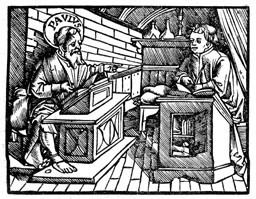
The picture: The Apostle Paul (dictating the book of Romans to his scribe, Tertius), in the Zurich Bible, 1536. Courtesy of the Digital Image Archive, Pitts Theology Library, Candler School of Theology, Emory University.


Comments
sandy Apr. 30, 2012 at 1:36 PM
from the law to grace ,, from grace to
heaven , yes paul was talking about the struggle at the time to comply with the law, of the old testament wich they had to obey and had hard time ,,, also at that period when jesus was presenting the power of grace trough his sacrifice was hard for people to accep the change... jesus was offering himself wich the follower of the law were having hard time acceting it........
Danny Apr. 30, 2012 at 2:04 PM
As Paul was a Jew prior to conversion, could the answer not be "All of the above?"
He would reasonably fit both those narratives based on his personal background.
Chris Plant Apr. 30, 2012 at 2:38 PM
I believe this interpretation is spot on. Especially if you just sit down and read chapter's 6-8, it just fit's contextually. If you read it as a Christian struggle then what Paul's ultimate point seems to contradict itself.
Murray Vasser Apr. 30, 2012 at 2:50 PM
Hi Dr. Manning,
Thanks for this post! I agree that Paul is not talking about his present experience or the experience of the Spirit led Christian.
However, wouldn't you agree that it is possible for a Christian not to "walk in the Spirit" (Gal. 5:16)? In other words, does every Christian walk in the Spirit every moment of every day? Surely the answer is no.
Therefore, if a Christian is not walking in the Spirit, won't his experience be analogous to the experience described by Paul in Romans 7?
You presented 2 options: Christian or non-Christian. It seems to me there is a third option: everyone (both Christian and non-Christian) striving to please God apart from the law. The Galatian Christians, for example, would fall into this category (Gal. 3:3).
Murray Vasser Apr. 30, 2012 at 2:52 PM
Correction: striving to please God apart from the *Spirit*
victor john shultz -'97 Apr. 30, 2012 at 3:29 PM
Hey Guys! Maybe you should sit down with Walt Russell. I believe I recall that he held the view that Paul was not speaking of his struggle with personal failings but the ever strong pull to revert to the Law.
David Costello Apr. 30, 2012 at 9:14 PM
Or could Paul simply be describing the dual nature of the Law. On the one hand the law condemns sin in the flesh, for the law fulfilled is Christ life, a life defined by living in the spirit, as he says earlier that the law outside of the flesh is perfect, it is the same law serving dual purposes. One the law is to be delighted in the spirit, and groaned against in the flesh. It condemns the flesh, and the sin to which the flesh is governed. Before the fall the law existed to be delighted in, after the fall it is disdained, a renewal of the spirit creates a trinity nature to that law. It is a law to sin, to the flesh, and to the spirit all serving different purposes.
Gary Manning May. 2, 2012 at 1:29 PM
Thanks for all your comments! Murray: yes, that is the third option; in fact, it also has a long history of interpretation. I tend to see it as a sub-category of the "Christian" view, and so my reasons above apply almost equally against that view. I like how you phrased that view, however. "Analogous," to me, suggest more of an application rather than Paul's original argument.
David: yes, I agree in part. Paul is trying to explain how the good Law could result in evil, more than he is trying to explain struggle with sin.
Victor: Maybe we can get Walt to post a response here. His view is mostly the same as I am presenting, I believe.
Daniel Jun. 18, 2012 at 4:32 PM
AMEN!
This is NOT a Christian; or else he would be refuting himself, when he said, "that the body of sin may be brought to nothing" and "sin shall not be your master, for you are not under law but under grace".
The man in Rom 7 is:
1. Trying to do the works of the Law (a Christian is not under the Law but grace)
2. Sold under sin (a Christian is redeemed)
3. Longs to be delivered from the body of death (through faith in Christ, the body of death is brought to nothing)
4. Thanks God that through Christ, his deliverance comes (because Christ brings the body of death to nothing)
5. Begins to talk about the Christian experience, where there is no condemnation
6. Condemns Christians who live for the flesh to "death" [Ro 8:13]
Elsewhere, he says Christ "leads us in triumph" - the frustration and failure of Paul in Rom 7 is nothing like "triumph".
Paul uses a lot of word-play; in another passage, when he says,
"But if, while we sought to be justified in Christ, we ourselves also were found sinners, is Christ a Minister of sin? God forbid.
For if I build up again those things which I destroyed, I prove myself a transgressor."
[Gal 2:16-18]
Who is the "I"? It is CHRIST he is speaking of:
1. Paul did not destroy the "body of death" [Rom 7:25]; Christ did!
2. Paul is not the one who was being called a transgressor; it was Christ.
Dell Russell Jul. 28, 2012 at 8:43 PM
Gary, What would it take to prove to your friend this is indeed a lost man in chapter 7? And indeed it is, that is if you believe Paul.
mick george Aug. 7, 2012 at 12:09 PM
I agree that Paul is speaking about the experience of a pre-conversion follower of the Law in Rom. 7:14-25. However, Paul is making a constant contrast between the person's faculties of the mind and the faculties of his body. He wants the law, delights the law and serves the law. And he concludes that with his mind he is a slave to God's law but with his body he serves the law of sin.
Yet, in Romans 8:7 it says that "the mind of the flesh is hostile to God, for it does not submit to the law nor is able to." How could the pre-converted mind want the law, delight in the law and serve the law since he is without the Holy Spirit?
Dell Russell Aug. 7, 2012 at 3:56 PM
@ mick george,
The key word is submit. Although the mind may delight in the law, it does not submit to it.
Go back and read chapter 2 again. There you will see how the lost Jew rested in the law, taught the law, and boasted of the law, but did not actually do the law. Delighting in the law is not a sign of salvation.
mick george Aug. 8, 2012 at 10:13 AM
Thanks Dell for your insight. Your right "submit" is the key word. Romans 2 is helpful too. However the mind of the Jew in Romans 2 is blind to his sinful state. Yet, the mind of the person of Rom. 7:14-25 seems to be convicted of his sin. One mind brags about the law yet is in denial of his sin. The other delights in the law and is painfully aware of his sin. It seems that bragging and delighting in the law come from two different mindsets even though they are both without the indwelling Spirit. I am thinking that the mind of 7:14-25 is the mind under the conviction of the Holy Spirit. Such a mind is influenced by the Holy Spirit but still unable to submit to God's law.
Dell Russell Aug. 8, 2012 at 8:11 PM
mick george,
The law was given to the Jew to be his school teacher, so it comes with conviction built in. There very well may be a slight difference in the man of chapter 7 and the ones Paul was speaking of in chapters 1-3, but probably only to the extent that the ones in chapters 1-3 have hardened their heart and the man of Romans 7 was still truly trying to keep the law, but saw his inability to do so.
As we go through the NT we have seen there truly were both kinds of Jews. Nicodemus comes to mind along with others when it comes to those that saw their lack. And we also saw those that had hardened their hearts and saw Jesus as a threat and wanted Him killed. Those that saw Jesus as a threat thought they were keeping the law even though they were not. Just a side note here, I don't know if any of them saw themselves completely without sin, as they did make sacrifice every year for their sin. So technically they all saw their lack in the end.
mick George Aug. 8, 2012 at 10:13 PM
Thanks Dell for taking the time to respond. You have given me much to think about.
Daniel Aug. 17, 2012 at 1:35 AM
Dell,
I believe justification came through faith in the Law - that is, faith in Moses's accusations [John 5], unto brokenness: the Law was the Ministry of Condemnation [2 Cor 3:9].
Remember in Luke the tax collector went home "justified" after beating his breast and crying for mercy; and Paul in Romans 7 was utterly demolished over his unrighteousness and recognized that there was something deficient in his body.
Justification was never through works of the Law [Rom 9:32]; rather, it was through faith in Moses's accusations, unto humility and asking for mercy - all who did NOT believe Moses's accusations "went about to prove their own righteousness" [Rom 10:3] through the works of the Law.
Daniel Aug. 17, 2012 at 1:40 AM
Their justification wasn't a complete perfection, though -
Hb 11:40
"since God had provided something better for us, that apart from us they should not be made perfect."
Hb 12:23
"To the general assembly and church of the firstborn, which are written in heaven, and to God the Judge of all, and to the spirits of JUST MEN MADE PERFECT,"
There were just and even "good-hearted" (good = humbled by their sinful circumstance) [Lk 8:15] people on earth BEFORE Christ came with the Gospel; but these men are "made perfect" by receiving Christ.
Dell Russell Aug. 17, 2012 at 3:22 PM
Danial, I'm not sure I am following you 100% here. I agree that one is saved by faith, and I agree that the law is there to point out our sinful condition.
do you do face book?
http://www.facebook.com/dell.russell.3
Daniel Aug. 25, 2012 at 9:36 AM
Just closed my account - I waste too much time on it.
Matt Barnum Feb. 17, 2013 at 4:24 PM
this is absolutely a "slam dunk" interpretational passage! it is essential in every christian's view of sanctification and it must be addressed!
Bill Hines Mar. 10, 2013 at 5:53 PM
I think Paul is talking about himself, referring indirectly to the "thorn in his flesh".
Bryan Ketler Mar. 20, 2013 at 9:19 PM
Have you heard Michael Pearl's teaching on Roman's 7? Agrees with you and really explains it well so a layman can understand. Go to www.nogreaterjoy.org. His whole teaching on the book of Romans, like 17 hours long, is available as a free download. Changed my life!
John Huckle Apr. 13, 2013 at 9:49 PM
The book of Romans is a transitional book. The Jews in his audience had been under the law since they lived before the Cross. Now after the Cross no part of Adam in them remained. They were now " in Christ." Romans 6 established that these Jews, having come to Christ, were now dead to sin consciousness. On the way to Romans 8 Paul pauses in Romans 7 to demonstrate a law based mentality. Finally in Romans 8 Paul demonstrates the freedom from the law. Believers today have never been under the law either before salvation or after so salvation so Romans 7 has no application to us. We would not miss anything of real value if we merely went from Romans 6 to Romans 8.